Ancient Greece
The Greeks of antiquity were the first to truly make use of their observations in a scientific manner, in order to deduce explanations for how the elements making up the sky actually worked. They had noticed that certain stars moved. These “πλάνητες ἀστέρες” (planetes asteres) or “wandering stars” quickly intrigued them, and they tried to understand how they worked.
Until Thalès of Miletus in 600 BCE, Earth was considered as a flat disk, like an island surrounded by an infinite expanse of water, the famous “Ocean”. But as early as Pythagoras (-500), the Earth, the Moon and the Sun were already considered to be spherical in shape, even if this was more through philosophical deduction rather than scientific demonstration. The following generation, notably Plato (-400), would spread this concept widely.
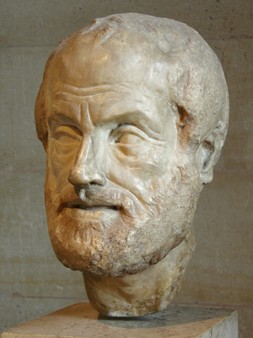
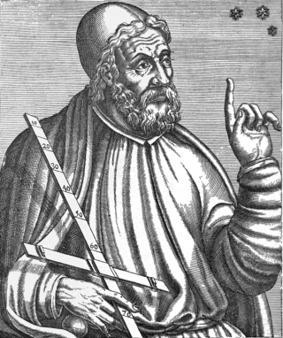
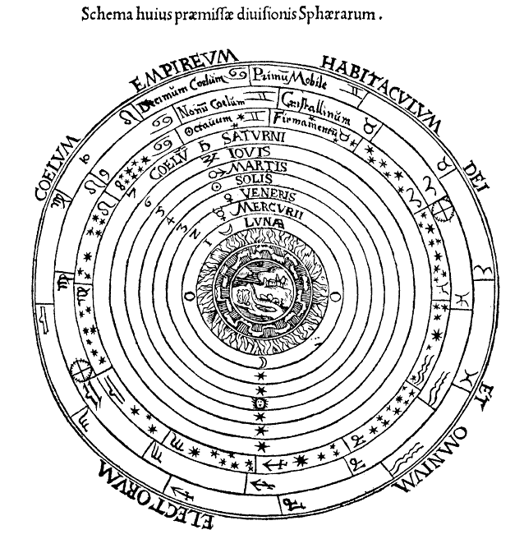
Then Aristotle (-330) stated the principle of the Earth lying motionless at the center of the Universe. This principle would be supported by Archimedes (-250), becoming the “Aristotelian dogma” that would endure until the 16th century, although some, like Aristarchus of Samos (-250), had already proposed a heliocentric model. Around the same time, Erathostenes carried out the first scientific (and relatively accurate) measurement of the Earth’s circumference (-250). Then Hipparchus (-140) developed the first star catalogues, and refined the movement of the celestial bodies, discovering the precession of the equinoxes. He also originated the concept of epicycles as an explanation for the apparent movement of the planets. Finally, Ptolemy compiled around +140 the most complete treatise of his time, the Almagest, which would be considered as a reference for many centuries.
The Middle Ages
Astronomy was used by many civilizations during the first millennium. The sky would be charted by Arab and Chinese scholars, and celestial events were recorded in highly official documents such as the dynastic records.
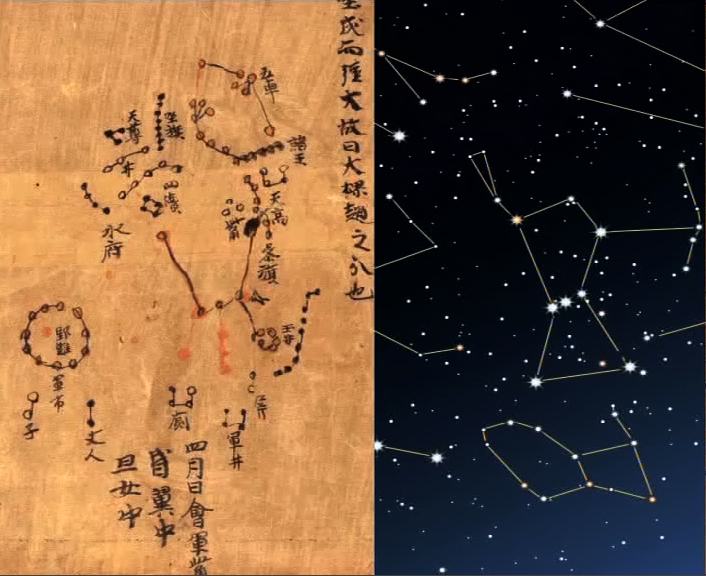
It must be said that in China, astronomy was a matter of state: from the Han dynasty onward, an imperial bureau employed civil-servant astronomers charged with recording every celestial event, as it could be read as an omen bearing on the emperor’s legitimacy – the “Mandate of Heaven”. This system produced archives that are almost continuous over more than two millennia: eclipses, comets, “guest stars“… The Dunhuang star chart (~700), containing more than 1,300 stars, is the oldest preserved star atlas in the world. It is this observational gold mine that would allow the 20th century to match the supernova of the year 1054 – precisely described – with the Crab Nebula. To learn more about the history of this nebula, it’s >>over here<<.
Source : https://irfu.cea.fr/Phocea/Vie_des_labos/Ast/ast.php?id_ast=2617
The scholars of the Arab-Muslim world did not merely chart the sky: they translated and preserved Greek works that might otherwise have been lost. They commented and corrected them. They also built large observatories – such as the one in Samarkand, founded by Ulugh Beg during the 15th century, whose catalogue of more than 1,000 stars surpassed Ptolemy’s in accuracy. It is largely thanks to this transmission that the European Renaissance would be able to build upon ancient knowledge.
Among these scholars, the astronomer Al-Sufi took up in the 10th century the knowledge of the ancient Greeks — particularly the Almagest — and carried out stellar cartography work (the Book of fixed stars in 964), estimating and correcting the magnitudes of the stars catalogued by Ptolemy. It is worth noting that he appears to have been among the first to report the observation of the Andromeda Galaxy, but also of the Large Magellanic Cloud (which he could not have observed himself from Persia, but is rather probable report from Arab navigators description). The names of the brightest stars in the sky are still largely inherited today from Arab astronomy.
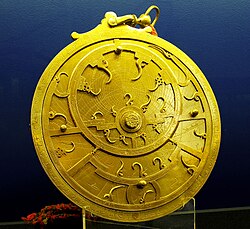
Astronomy then became essential in many fields.
- For navigation, by finding one’s way with the help of the constellations, then with the measurement of Latitude
- For agriculture, by providing more precise information on the seasons through measuring the position of the stars, and thus better planning the work in the fields.
It was of course still widely used for religion, making it possible to calculate feast days such as Easter. It was then still called “astrology” and could not yet be separated from the beliefs people held, in particular concerning the position of the planets in the constellations of the zodiac, which influenced the medicine of the time.
In the West, notable achievements included the transcription of Greek and Arab texts by Gerard of Cremona in the 12th century in Toledo – including a Latin version of the Almagest which would remain the reference for centuries – and then the publication of the Alphonsine Tables in the 13th century, commissioned by Alfonso X of Castile, which would serve as the reference for all of Europe until the Renaissance.
But humanity also became aware that the universe was not “immutable”. Europeans recorded the “new” stars (stella nova) which appeared and then disappeared in the night sky. The appearance of comets was documented, which would later make it possible to establish their periodicity.
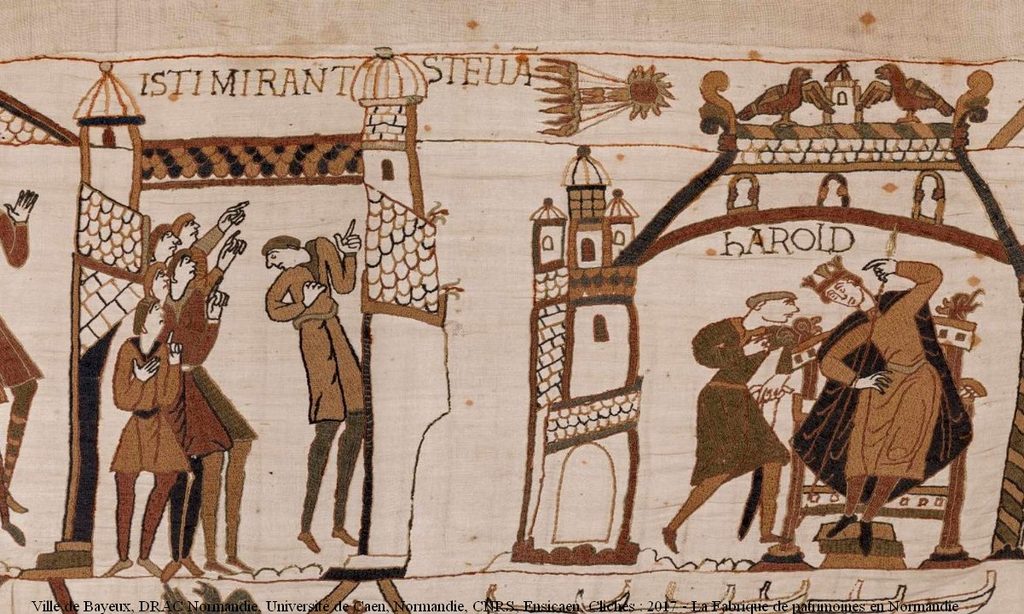
Finally, the increasingly precise measurements of the positions of the planets began to show the limits of Ptolemy’s geocentric model. Additions such as epicycles were no longer sufficient to explain the ever more accurate measurements. The evidence had to be faced: at the dawn of the 16th century, the time had come to rethink our perception of the universe, despite the dogmas.