The Latest Developments
Since the second half of the 20th century, new discoveries have strongly put into question what we thought we knew about the Universe. These discoveries were made possible by a true industrialization of observational capabilities.
Digital, Industrial and Space Astronomy
From the 1970s onward, photography became digital, first with the polarimeters aboard the Pioneer probes, then the Vidicon tubes on board the Voyager probes. Then the advent of the CCD sensor superseded film photography in the 1980s. These great space programs renewed our perception of space with tremendous progress in our understanding of the formation of the Solar System. They also contributed greatly in making astronomy popular with the public — the American agencies such as NASA or JPL having always done a remarkable communication work, even if the Europeans have caught up well these days on this matter.
This digitization also represents automation, which now makes it possible to operate observatories remotely, and it became relevant to relocate data acquisition to the most suitable places on Earth, to escape light and atmospheric pollution. This is what gave rise to the great observatory projects in Hawaii or in South America with ESO. These sites currently host the largest telescopes in the world, including the ELT project. This automation also makes it possible to program systematic sky survey operations, with flagship projects such as the Sloan Digital Sky Survey for the deep sky, or the Hipparcos and then Gaia missions for astrometry, the latest survey of which records the position of more than 2 billion objects.
Finally, digitization is also miniaturization, which makes it possible to embed highly efficient imagers in observatories that are now sent into space, such as the Hubble Space Telescope, which represents in itself a new revolution in sky observation, as it is now possible to break free from the Earth’s atmosphere that limits observations.
Dark Matter
In 1933, Fritz Zwicky measured the motion of galaxies, and was the first to see that the estimated “luminous” mass and the “gravitational” mass measured in the interactions between galaxies did not match. Galaxy clusters are much “heavier” than they should be. But at that time, the scientific world was focused by the topic of the expansion of the Universe and his work was not followed up.
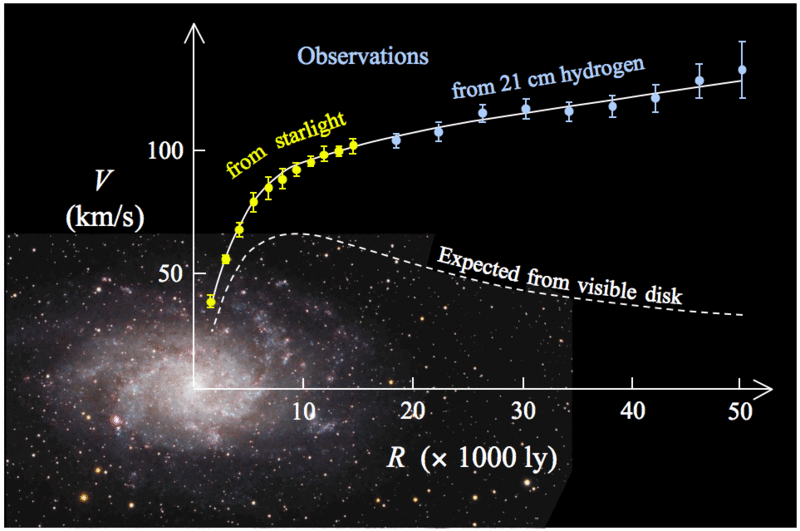
It was not until the 1960s and the measurements of the differential rotation of galaxies carried out by Louise Volders, then by Vera Rubin, that the same problem was highlighted: the rotation of the outer elements is almost synchronous with those of the core, which suggests that a lot of matter exists around the “visible” parts of galaxies, but which is totally hidden from our observations. This invisible matter was then named Dark Matter. And it represents a significant energy budget in proportion to the content of the universe.

Meanwhile, cosmology progressed in the understanding of the Big Bang, with the concept of Inflation which explains the anisotropies of the Universe, as well as the behavior of black holes, particularly with Stephen Hawking. The latter also worked on “Multiverse” theories — which have not come to fruition to this day.
Dark Energy
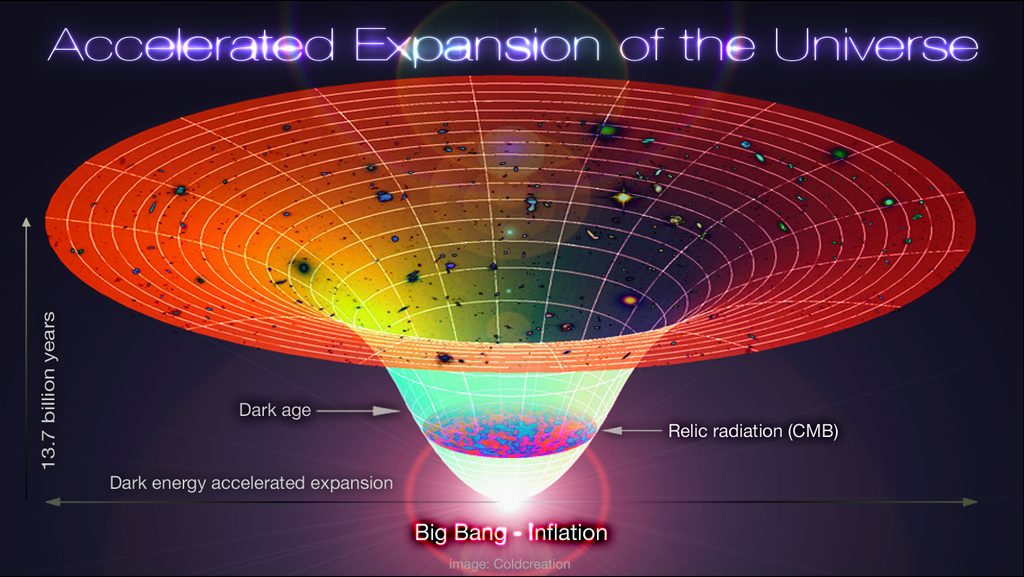
Finally, in 1998, two independent teams, one led by Saul Perlmutter, the other by Adam Riess and Brian Schmidt, carried out distance measurements by observing distant supernovae. These observations also aimed at refining the measurement of the expansion rate of the universe. They then discovered that this expansion rate had increased over the last few billion years. In other words: the expansion of the universe is accelerating. This discovery earned them the Nobel Prize in Physics in 2011.



The most obvious explanation for this phenomenon is that a source of energy is causing this acceleration. The amount of energy required is colossal, as it must counteract gravitation, which tends to bring the components of the universe closer together. But almost nothing is yet known about this energy, which was then dubbed Dark Energy.
Today, if we are to account of what our Universe is made of, we can no longer think only in terms of the objects we see. Since the beginning of human History, we have essentially used our eyes to observe and understand the universe. But we find that light – or more exactly the messenger of the electromagnetic force represented by the photon – does not allow us to observe everything.
We must therefore think in terms of energy budget, which of course includes physical objects by virtue of Einstein’s relation E = mc². Here is then the breakdown of the energetic “weight” of the different components of the universe, according to the current standard model, called ΛCDM (Lambda for Dark Energy, and CDM for “Cold Dark Matter”):
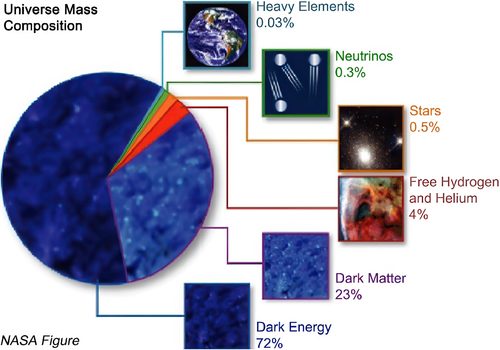
In summary, all the progress accomplished since Antiquity leads us to note that we see only a little less than 5% of the Universe. So we know that we do not know everything… and that is not fundamentally a negative thing, as it also means that there is still so much left to discover…
Multi-messenger Astronomy
To “see further” than the classically observable 5%, we must therefore mkae use of other “messengers” than the carrier of the electromagnetic force. Of the 4 fundamental forces of nature, only two are long-range (electromagnetism and gravitation). Since 2015, astronomers have begun to observe the sky through gravitational waves, providing along the way a new proof of the theory of General Relativity.
But we can also in some way say that we observe the other two forces of nature (the strong and weak nuclear forces), by observing their residue. The observation of neutrinos is difficult because these particles interact very little with matter, but there are neutrino telescopes in service around the world. The observation of “cosmic rays” is also another active field of current astronomy.
The cutting edge of astronomical observation is reached as soon as we have the opportunity to observe these different messengers simultaneously, which notably occurred during a collision of neutron stars in 2017. This is called multi-messenger astronomy.
Exoplanets
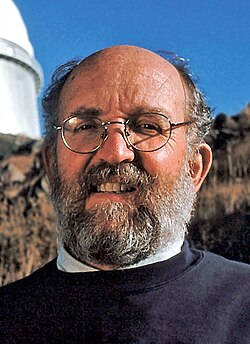
The latest developments in modern astronomy are not only about the distant Universe. Giordano Bruno had dreamt of it, but Michel Mayor and Didier Queloz eventually obtained the first proof of the existence of a planet orbiting another star. This is 51 Pegasi b, discovered in 1995, which earned its discoverers a Nobel Prize in 2019.
Since then, several missions, notably space missions, in particular the CoRoT and Kepler missions, have enabled the detection of thousands of extrasolar planets, and it is now estimated that one star in two in our Galaxy has a retinue of planets. Some even have a complexity comparable to ours, such as the TRAPPIST-1 system.

As a conclusion…
Astronomy is currently a very active domain. We have learned to observe the sky, further and further, with ever greater resources, using more and more messages. Observation has moved out into space, especially with the iconic and highly publicized missions that are Voyager or the Hubble Space Telescope. Current scientific missions, such as JWST, the “Vera Rubin” telescope, or the “Euclid” or “Nancy Grace Roman” missions, seek to answer the most recent open questions about the Universe and its evolution…
Astronomy’s history is not over yet 🙂
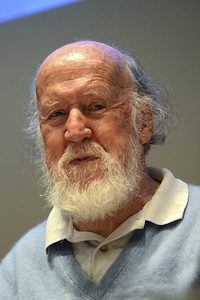
Modern astronomy has also become public and popular. Like Camille Flammarion or Robert Ball in their time, many scientists today are also “science popularizers” for the public. In particular Carl Sagan has to be mentionned, as he was one of the most important popularizers of the 20th century, as well as Hubert Reeves or André Brahic for French speakers, or Neil deGrasse Tyson for English speakers. There are many others currently “on duty”, who let us discover astronomy in all its beauty and all its complexity, and who will also go down in History. Without them, amateurs like us would know only a fraction of what is currently accessible to us.



Bibliography
https://fr.wikipedia.org/wiki/Histoire_de_l%27astronomie