Charting the sky
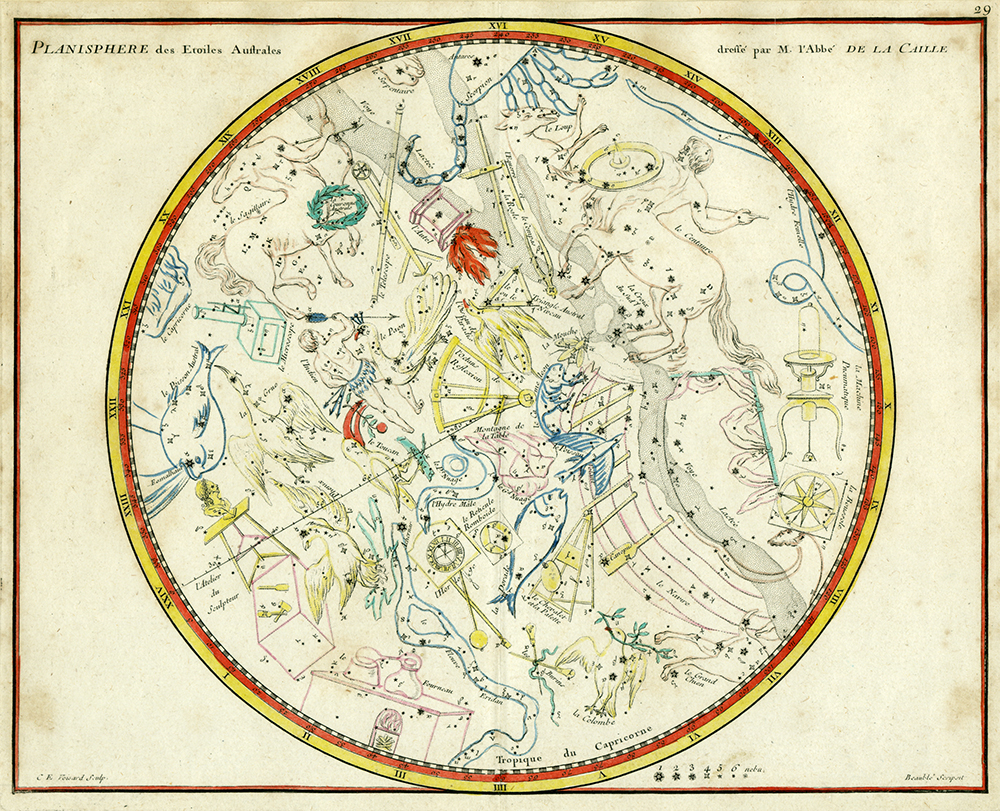
Several astronomers began a methodical charting of the sky in the 17th century. One can notably mention John Flamsteed, the first director of the Greenwich Observatory, and his star catalogue (the Flamsteed designation is still partly used today). There was also Abbé Lacaille, who accumulated a great deal of observations, particularly in the southern hemisphere, naming 14 southern constellations. In 1751, Lacaille carried out a precise measurement of the Earth-Moon distance (using the parallax) with Jérôme Lalande, who would also publish an enormous catalogue of 50,000 stars in 1801.
Towards the “deep” sky
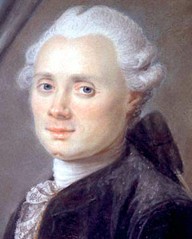
In France, under the reign of Louis XV, the discovery and tracking of comets was an important field, still tied to the potential omens they carried. Charles Messier, recognized as an eminent “comet hunter” by the King, observed the sky with instruments of about 8 inches of aperture. He then discovered and catalogued, with the help of Pierre Méchain, “deep sky objects of diffuse appearance” which were not comets but could mislead hunters. He grouped them together in a catalogue published between 1774 and 1781.
At that time, the nature of the objects being observed was not yet understood. Most were moreover relatively “fuzzy” at the eyepiece of the instruments used. They were grouped under the very generic term “Nebulae”, even though these objects varied greatly in size, distance, and above all in nature.
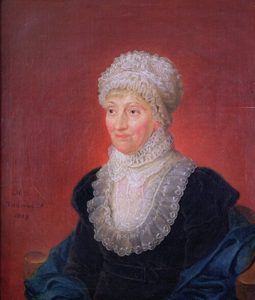
In parallel, William Herschel and his sister Caroline (who was the first professional female astronomer, in the sense that she would be paid for her scientific work) built and sold their own instruments. They observed and catalogued numerous stars and deep-sky objects, which they would bring together in a “Catalogue of Nebulae and Clusters of Stars” in 1786.
This catalogue would later be extended by John Herschel, William’s son, to become the “General Catalogue” in 1864, then it would be profoundly extended and reworked by John Dreyer up to 1888 to become the “New General Catalogue” we know today.
Thus, by the end of the 19th century, the “nearby” universe — that is, essentially the solar system and the visible stars — was relatively well determined, but the “distant” universe remained very nebulous, this term being applied to any object whose nature was not yet understood. Astronomy also gradually became “popular”, notably thanks to the work of popularizers like Camille Flammarion or Sir Robert Ball.
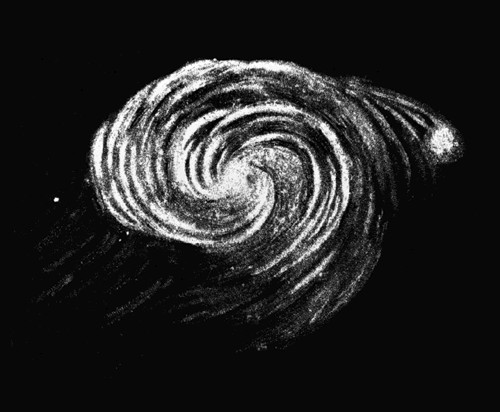
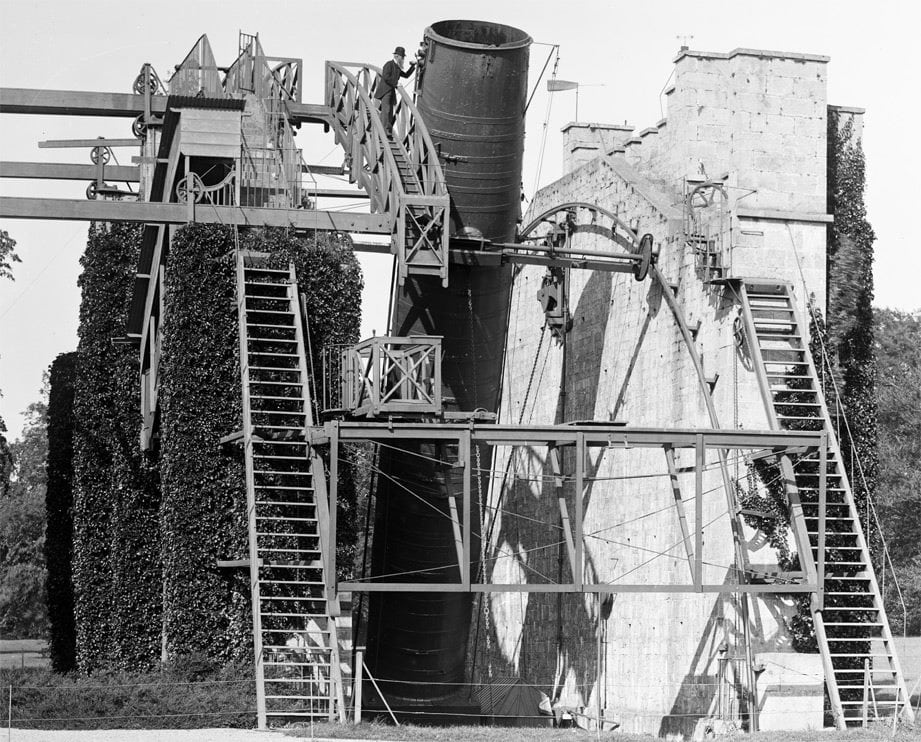
Yet the construction of ever larger telescopes brought more and more detail on these objects. In 1845, Lord Rosse, having built a telescope 72 inches in diameter (the largest in the world until 1917), produced several drawings, including one of Messier 51 which clearly revealed the spiral nature of this nebula. This telescope was also used by other astronomers, such as John Dreyer.
In parallel, William Herschel’s observation of several compact objects comparable in size and color to the recently discovered Uranus would give rise to the name “Planetary Nebula“. Lord Rosse carried out similar observations, notably on Messier 97. Those nebulae were identified much later as stellar and not planetary origin.
The 20th century would carry our vision beyond the Milky Way to finally understand the nature of the Universe.