Locating the “horsehead” nebula in visual observation
It is one of the most famous objects, highly prized by astrophotographers, yet very difficult to detect and appreciate visually. And for good reason: it is a dark nebula, a cold molecular gas cloud that emits no light in the visible spectrum. Observing it relies on a “stroke of luck”—the fact that this nebula is in the foreground relative to a hydrogen cloud, which reflects the result of its own ionization back to us. Consequently, the nebula becomes visible, in a way, “backlit”. But even so, the background cloud emits in deep red, a wavelength to which the human eye is only moderately sensitive. This makes it a complex object to observe.
In photos, the Horsehead Nebula looks like this:
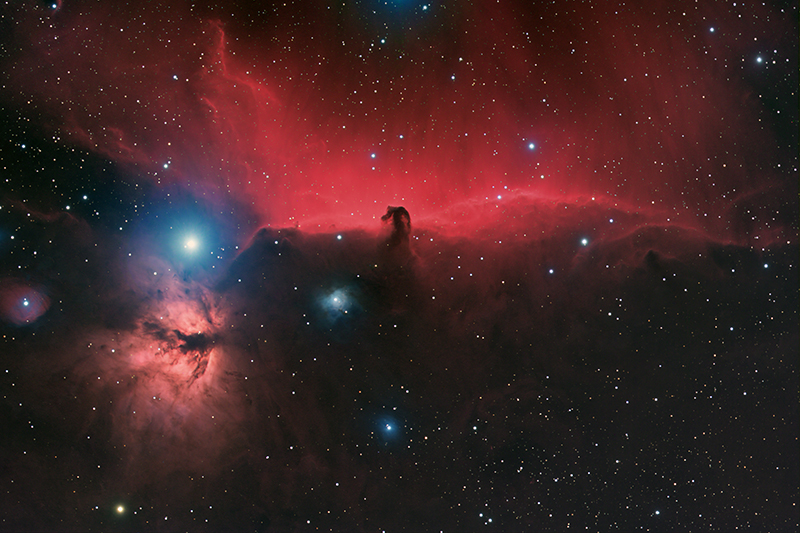
Let’s make it clear right away: there is no way you will catch a glimpse of such a panorama visually. This remains the exclusive domain of astrophotography. Observing the Horsehead Nebula is more of a challenge than an artistic experience. Although, it depends on the quality of your sky… but let’s focus on the hardest part: locating this object in the night sky.
To do this, you will need:
- A rather large telescope: Let’s say a 400 mm (16-inch) Dobsonian is not too much to claim to hunt down the beast without too much trouble.
- A high-quality sky: Especially with excellent atmospheric transparency, given the faintness of the object.
- A premium H-beta filter.
- A long focal length eyepiece: To get a low magnification (no more than 60x) and gather as much light as possible. The filter will handle the contrast. The apparent field of view (AFOV) is not critical, but a wide-field eyepiece can help place the target in the right spot.
- Dark adaptation time: To achieve your night vision (scotopic vision).
As a reminder, the Horsehead Nebula proper, cataloged as Barnard 33, sits right in front of an emission nebula designated as IC 434. The latter is an H II region, meaning it is primarily composed of ionized hydrogen. This hydrogen emits light at different wavelengths, corresponding to the energy transitions of the Balmer series—mainly the first one (alpha, which accounts for its red color). However, light is also emitted during the second transition (beta) which, although fainter, is located in the green part of the spectrum—a color to which the human eye is far more sensitive. Hence the use of an H-beta filter, which allows us to “see” these hydrogen nebulae in the green wavelength.
Location
Let’s start from the beginning: the Horsehead Nebula is located just below the leftmost star of Orion’s Belt. This star is named “Alnitak”. Therefore, it is situated slightly above the Great Orion Nebula.
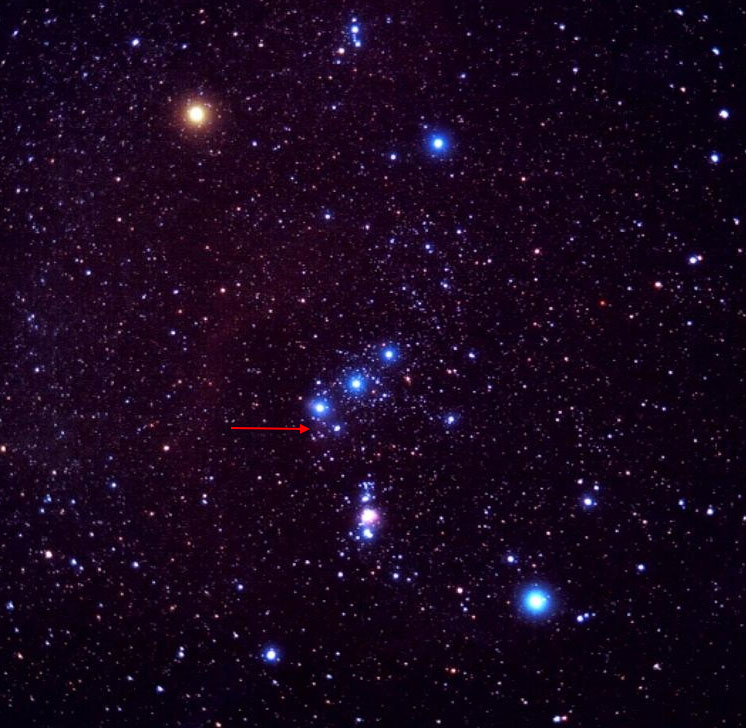
Therefore, you must start by centering Alnitak, which is quite easy for anyone. The resulting field of view should look something like this, keeping in mind that a Dobsonian-type telescope will invert the image.
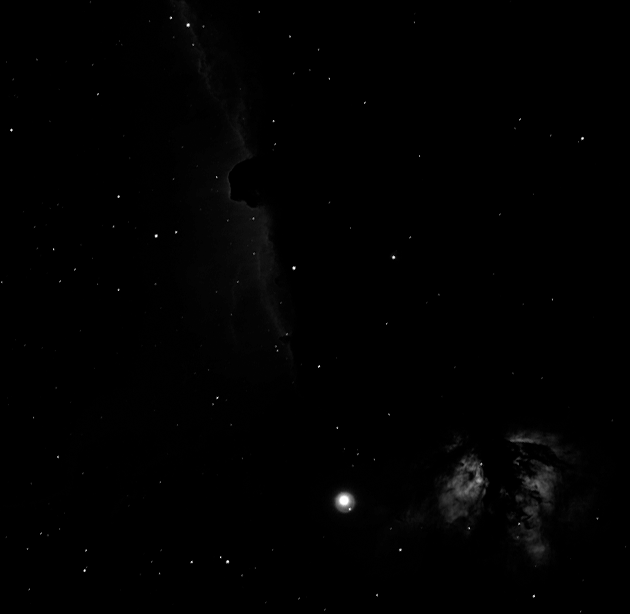
To the “right” of Alnitak, it is fairly easy to spot the Flame Nebula, which appears as two faint, gray patches separated by a rather sharp dark lane. If you have a dark sky and/or a powerful telescope, you might see the lanes branching out across this beautiful nebula. Our coveted Horsehead is located above it. However, the major issue at this stage is Alnitak itself, which is bright enough to glare your vision and prevent you from discerning the nebula, even with the H-beta filter.
The trick then consists in occulting the star, and to do this, you simply need to position the telescope so that Alnitak is just off-field (outside the field of view). This way, its glare no longer interferes with your vision. Alright, but then how do you find your bearings to precisely locate our “horsey”? The answer is below:
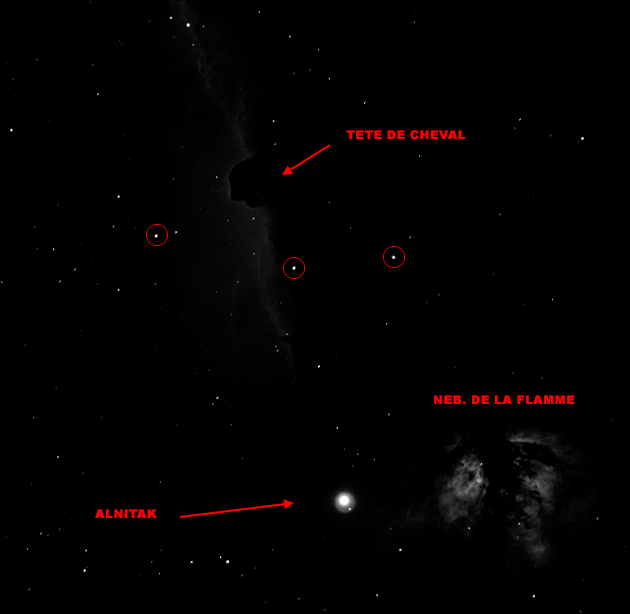
Your goal is to spot the three stars underlined in red, which form a kind of arc. The leftmost star is slightly further away than the rightmost one. Position this asterism near the edge of your field of view to keep Alnitak off-field. The Horsehead Nebula is to be found just above the central star.
First, you need to bring out IC 434, which means discerning the “bright” section on the left side, as opposed to the “dark” section on the right side. Gradually, the nebula becomes visible. Once you know how to spot it, you can focus on the “border” between the nebula on the left and the dark region on the right. Your goal then is to locate a “hole” or, more precisely, a “bay” cutting into the bright area. As the photo illustrates, you will not see the distinct horsehead shape that we admire in pictures. So do not try to look for a specific shape—just a “missing piece.”
There you go, you have successfully located the delicate Barnard 33! Once you have spotted it, you can train your eye on it to learn how to “feel it with your eyes”… in my opinion, there is no need to look for fine details during your first observation. The important thing is to spot it, which takes time the first time around but becomes much easier on subsequent nights. And indeed: as with many deep-sky objects, you will need to be patient and return to it on several occasions. That is how you manage to find it easily and observe it with increasing detail, as both your eye and brain have “learned” how to target and see it.
So, step up to your eyepieces, and happy hunting!