2016, September, the 8th
Introduction
Après environ 5 ans a utiliser avec succès un Celestron C11 classique sur une EQ-6 en photo du ciel profond, puis une période ou je After about 5 years of successfully using a classic Celestron C11 on an EQ-6 for deep-sky astrophotography, followed by a period where I stepped away from imaging due to work and renovating a countryside house, I wanted to get back into it and move up to the next level. Luckily, I had saved up some money and had a nice budget to build a more powerful setup.
My goal is still deep-sky photography—nothing else—with a preference for galaxies (yes, I know it’s the hardest, but that’s just how it is 🙂 ). So I started looking into which optics would allow me to excel in this field. Naturally, I quickly began considering Ritchey-Chrétien telescopes… There were also ultra-short Newtons, Dall-Kirkhams, or even Ricci-Honders, but between their exotic nature, difficulty of use, and issues with certain manufacturers, I couldn’t make up my mind…
In the end, I stuck with a Ritchey-Chrétien. This optical design is interesting for several reasons:
- It’s a symmetrical optic (no overhang like with Newtons).
- An F/D of 8 isn’t extremely short, but it’s below the F/D 10 of SCTs.
- In its bare configuration, light undergoes only two reflections, like with a Newton, so in principle, chromatic aberrations are eliminated.
- Above all, the field is supposed to be largely free of geometric aberrations: no more coma from Newtons or SCTs, and if the CCD isn’t too large, no corrector is needed.
However, there are downsides:
- It’s expensive…
- … very expensive!
- The F/D is still quite long, but I’ve heard that with certain correctors like AstroPhysics’ CCDT67, it works perfectly.
- It’s obstructed, which a priori rules out planetary imaging.
- And mechanically, it requires serious construction, with carbon/aluminum, and it’s heavy… The EQ-6 is no longer an option; I need to move up to a much more robust mount.
In fact, I chose the mount first, as its budget is also substantial, similar to the optics, and it was on my mind just as much, if not more. I finally went for an AP 1100 GTO, purchased at RCE 2014. In one word—because this isn’t the place to go into detail: it’s amazing, and a true joy that makes me forget all other EQ mounts on Earth…
I initially decided not to change my CCD (KAI 4022). I settled for revisiting the optical train at the divider level to ensure good rigidity for the entire setup. But I wanted my optics to be able to accommodate more powerful—and especially larger—CCD cameras in the future.
Why CFF ?
So, the time came to make a choice. I looked at the market’s Ritchey-Chrétien offerings… I visited a few well-known shops, got their opinions, and browsed the forums. It became clear to me that there are two types of players:
On one side, there are what I’d call the “canonical” brands: Alluna, Officina Stellare, RCOS, or more recently AstroSib… All of them make stunning, exceptionally high-quality tubes, but they have two critical drawbacks for me:
- The diameter usually starts at 400mm (350mm for some), which immediately means 25 to 30 kg—way too heavy for me to transport. Plus, these focal lengths are more suited to lunar or planetary observing, not exactly compatible with the typical French seeing conditions.
- The price… let’s be honest, it costs an arm and a leg, and I still need my arms—if only to work and fund my passion!
On the other side, there’s GSO, which is shaking things up with a very attractive Ritchey-Chrétien offering (by the way, GSO/Kepler/TPO are all the same company).
- They start at 150mm.
- The mechanical quality has improved with truss tubes. It’s not perfect, but it seems “fixable,” which suits me fine—I know how to tinker! 🙂
- The price is reasonable.
Shops speak highly of them, as do forum users who own them…
… but I’m skeptical about the optics. With GSO, it’s a lottery, and according to some, these might be “quasi” RCs with a non-hyperbolic secondary to cut costs, which doesn’t surprise me much…
In my opinion, there’s a gap in the market between these two offerings… and then I stumbled upon the CFF brand, which stands for “Coma Free Field.” That’s a bold claim! It’s not French, but it’s not Chinese either. It’s manufactured in Eastern Europe (CFF’s owner, Mr. Catalin Fus, is Polish, and the optician for the mirrors, Mr. Octavian Stanescu, is Romanian). Why not? The advertised optical quality is excellent, and the photos suggest solid mechanics. Most importantly, they offer sizes starting at 250mm up to 400mm—right in my target range.
I had a lot of trouble finding information about these tubes. CFF positions itself at the high end and is starting to build a reputation for its astro refractors, which—if I understand correctly—rival TMB or even TEC in terms of quality (I admit I didn’t look into it further). But nothing on their telescopes. Basically, they’re sold everywhere, but no one has them, even across the pond. A well-known shop—that actually sells them—discouraged me from buying one. Okay, I went back to investigating, but six months later, I was still at square one.
Then I saw that Skyvision listed RCs on its website. Great! Plus, it’s a French company! But they stopped making them—too many issues and not enough sales, they told me. A shame. However, they also distribute CFF and are quite positive about these tubes. And since Skyvision has a good reputation, I decided to take the risk, take the plunge, and order two 300/2400 optical tubes from them (a friend of mine also wanted to take the leap, and since we have the same CCD cameras, the prospect of collaborating on photos convinced us).
Almost a year later—after manufacturing, delivery, setup, and adjustments—I was finally operational with this
Optical formula
The Ritchey-Chrétien design, with its two hyperbolic surfaces, provides a wide field that is supposed to be free of coma. However, there is still some field curvature, which is ultimately corrected with a doublet lens. CFF even includes this field corrector as standard, and as a bonus, it is removable—something I find very interesting because, with small sensors like the 4022, the tolerances are sufficient to do without it.
The big downside, as with SCTs, is that the primary mirror is very short (F/D 3 in this case), and the obstruction is large—about 50% linearly. In terms of light collected, you ultimately get barely more than a C11, and as mentioned earlier, the contrast takes a significant hit. This theoretically makes the tube unsuitable for planetary photography. Personally, I don’t care about that, but it’s worth noting that this tube lacks the versatility of an SCT.
Options
CFF offers a range of options to customize the OTA (Optical Tube Assembly) to be more or less high-end, depending on your budget. These include:
- A heating system for the primary and secondary mirrors
- A quartz or even Zerodur mirror (to reduce thermal expansion)
- A secondary mirror mapping system via translation, like those from premium brands
- Various focusers, including the excellent Gemini Integra (which combines focusing and derotation, similar to the Pyxis or RCOS rotators)
For reference, the base price starts around €7,000 and increases depending on the chosen options (the quartz mirror option is quite expensive…). All of this is detailed on the CFF and its dealers’ websites.
For my part, I opted for the quartz mirror and secondary focusing. My friend chose a focuser/rotator, whereas I “settled” for a Feather Touch 3. The tubes we received are stamped “CFF Skyvision” and bear serial numbers 005 and 006—I’m not sure if this numbering is specific to Skyvision or CFF, but Thierry Ruiz didn’t give me the impression they were selling huge quantities..
Unboxing

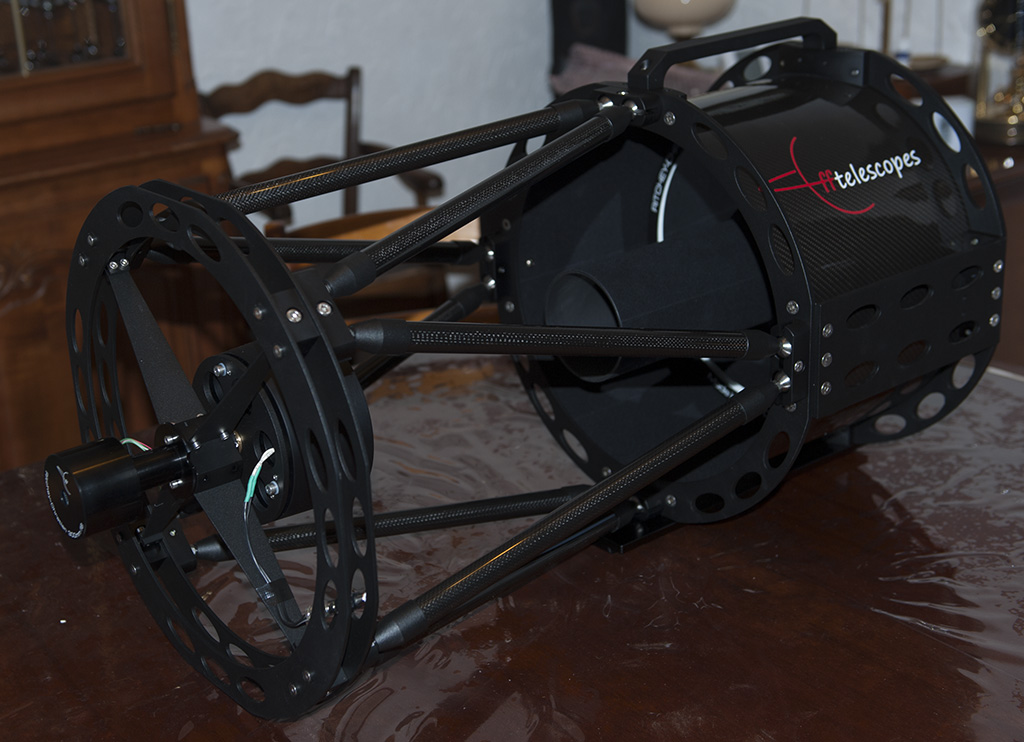
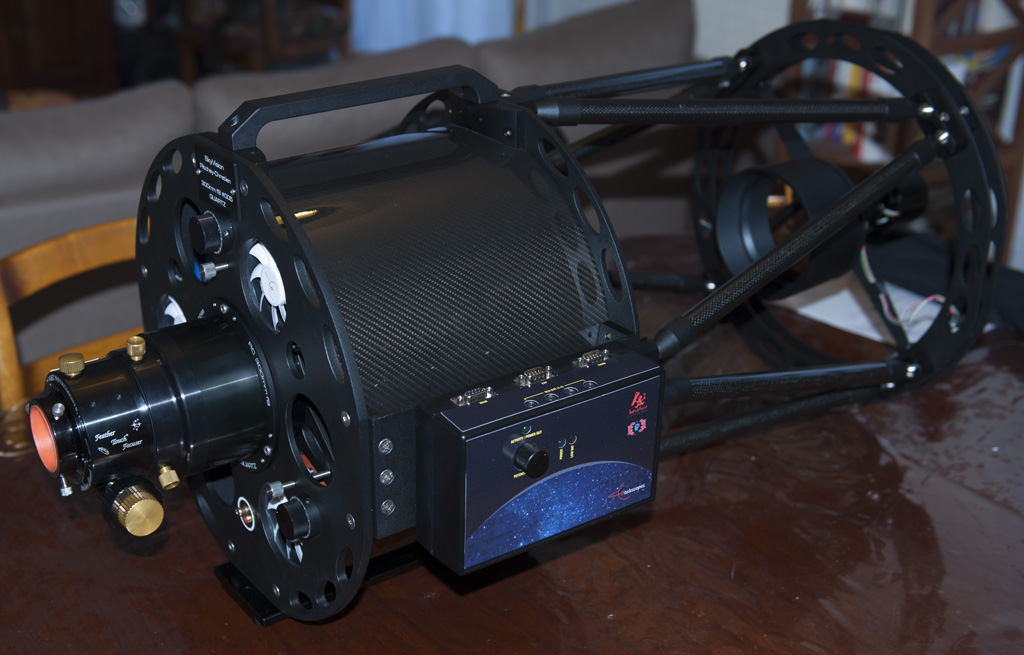
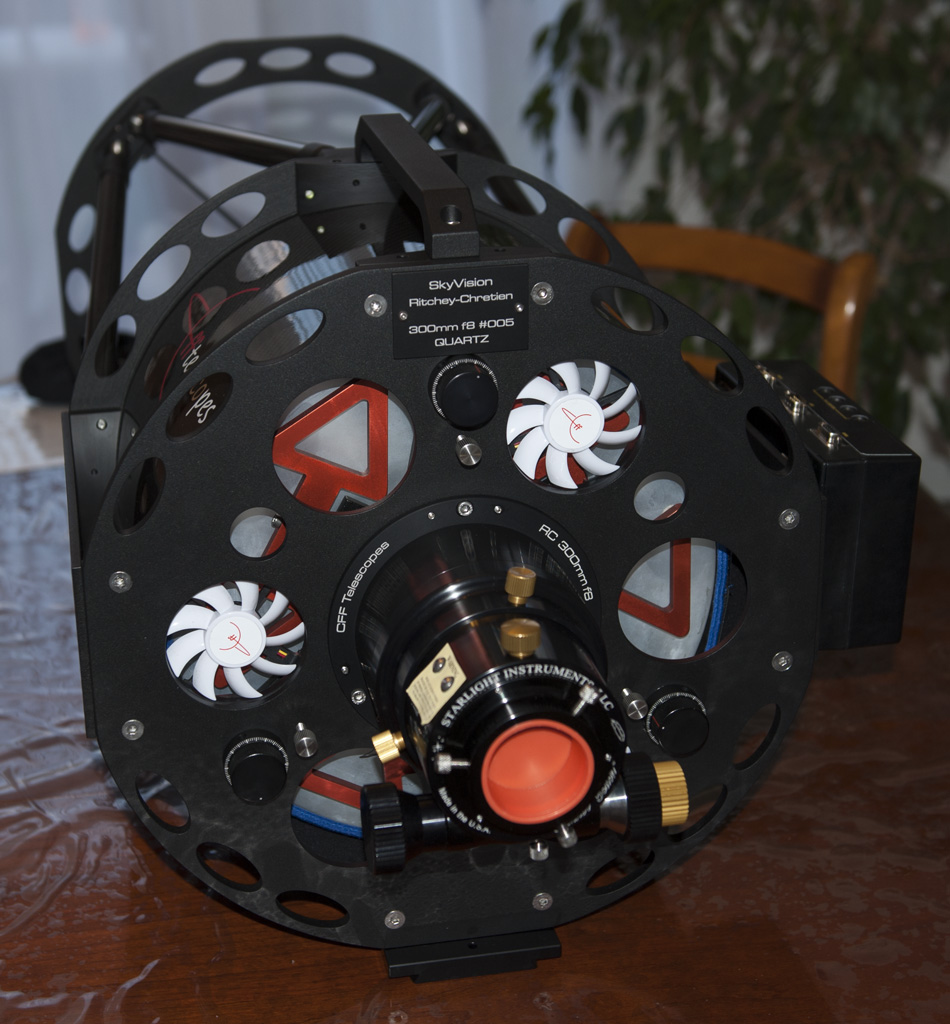
- For a 300mm, it’s quite wide! However, it’s only 1 meter long—clearly less compact than an SCT or even a Newton, but in terms of length, it fits in the car, so I’m happy with that.
- The overall build quality is impressive: anodized parts, flawless aluminum/stainless steel, and carbon fiber. No loose screws or other issues (plus, Skyvision performed a quality check before delivery).
- The optical train is fully adjustable (focuser tilt, secondary tilt, primary orientation) with locking screws.
- The secondary and primary baffles are substantial, effectively blocking stray light.
- The truss structure is solid, with everything mounted on well-tightened ball joints. There’s no stress on the carbon tubes, and rigidity is excellent.
- The primary mirror cell seems well-designed, with 6 floating support points (rigid triangles) plus 3 lateral support points at 120° intervals.
- The primary mirror collimation screws are reinforced with strong springs, so collimation holds well (it survives disassembly/reassembly on the equatorial mount with minimal readjustment).
- The total weight is around 20 kg, which I don’t consider excessive.
- The focusing/heating/ventilation system is controlled by a Seletek box, which seems excellent and expandable. It’s ASCOM-compatible and includes an RJ-45 port for automation :).
- Note: On versions without secondary focusing, the secondary mirror can still be manually translated, allowing a wide back-focus range (comparable to an SCT). This is very useful for adapting to multiple imager configurations.
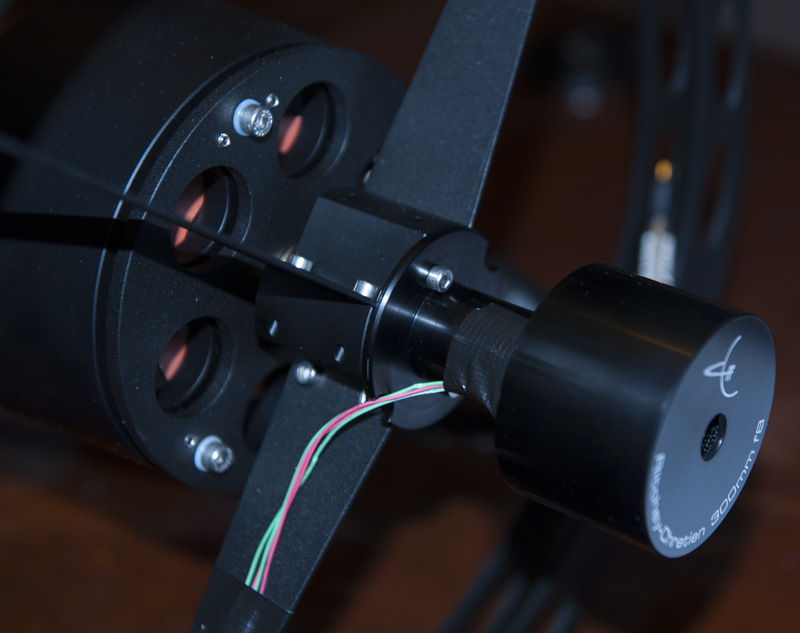
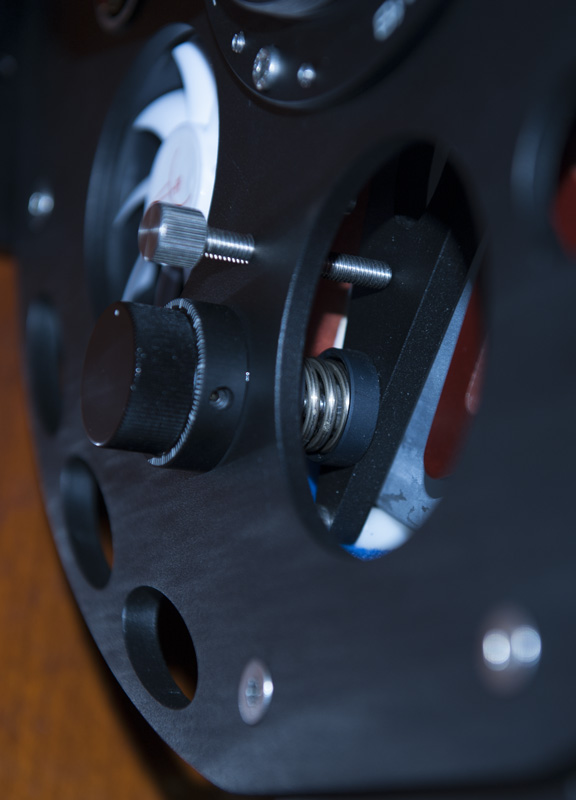
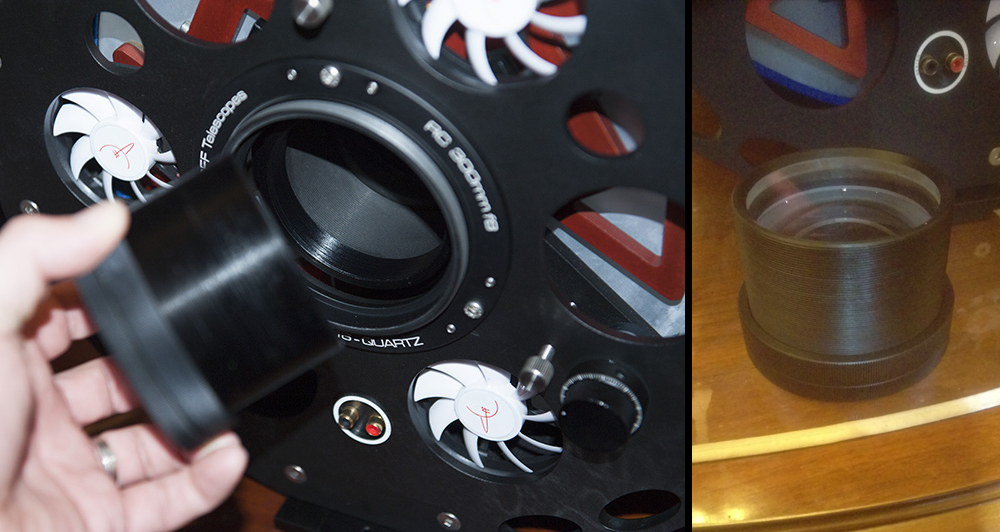
I don’t yet have enough experience to give a definitive verdict, but the mirror surfaces are clean, and the secondary has a collimation peephole. I received CFF’s inspection report, and the Strehl ratio is 0.97, which is excellent. Ultimately, a firmer opinion will come with use :). However, the field correctors arrived in questionable condition. They were sent back to the manufacturer, and I haven’t had a chance to test them yet.
My tube wasn’t fully “prepared” in the sense that the wires and connectors were shipped separately (and the power supply for the Seletek was missing). So I had to assemble everything myself and glue the secondary heating resistor (though the primary’s heating element was pre-installed with a surface connector, which is very clean). Personally, this works fine for me—I enjoy doing the setup myself—but it might bother some users.
The user manual is quite brief, with just a few instructions for adjusting focus with the Seletek. For those interested, I partially translated the Seletek documentation into French for my friend, and I have it available.
In use
I’ve been using the scope seriously since May. Mechanically, everything holds up well. I assemble and disassemble it each time, and with a minor adjustment to the primary mirror, the collimation remains stable over time—so I’m quite satisfied on that front. Overall, the tube is sturdy, and I don’t get the sense that it flexes (collimation would reveal that if it did). Of course, it’s still made of aluminum, so thermal expansion is a factor, and maintaining focus was challenging during the heatwave (with temperatures swinging between 35°C during the day and 18°C at night). However, I didn’t notice anything alarming. The ventilation is gentle and doesn’t cause vibrations in the setup.
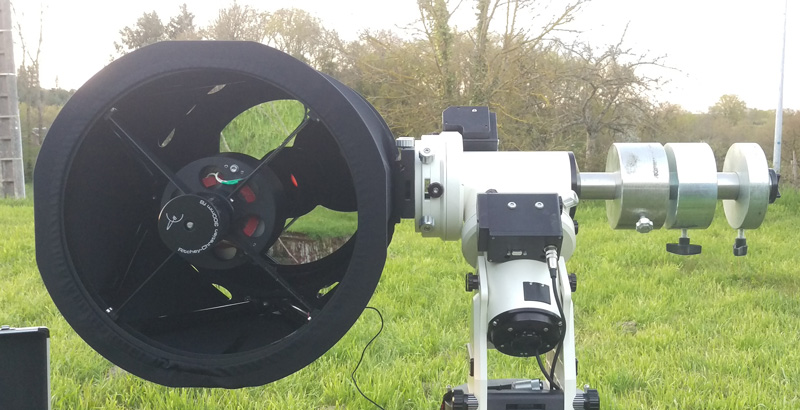
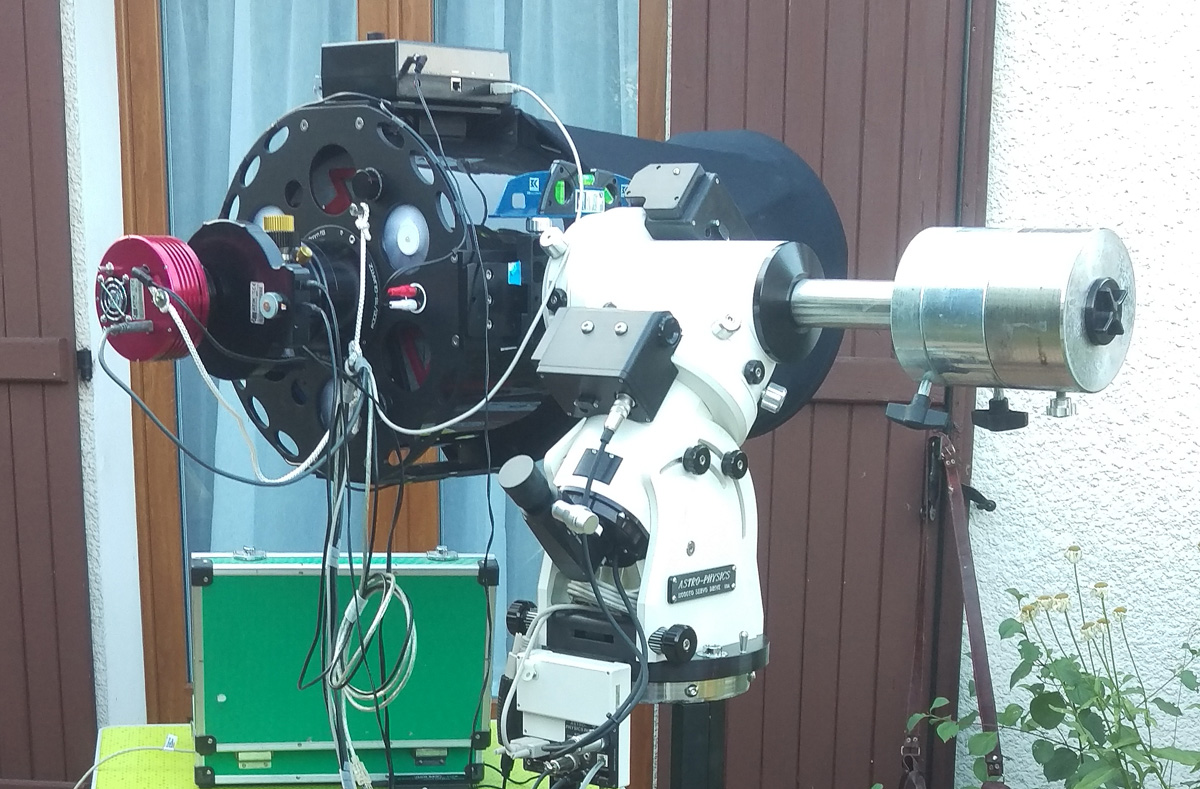
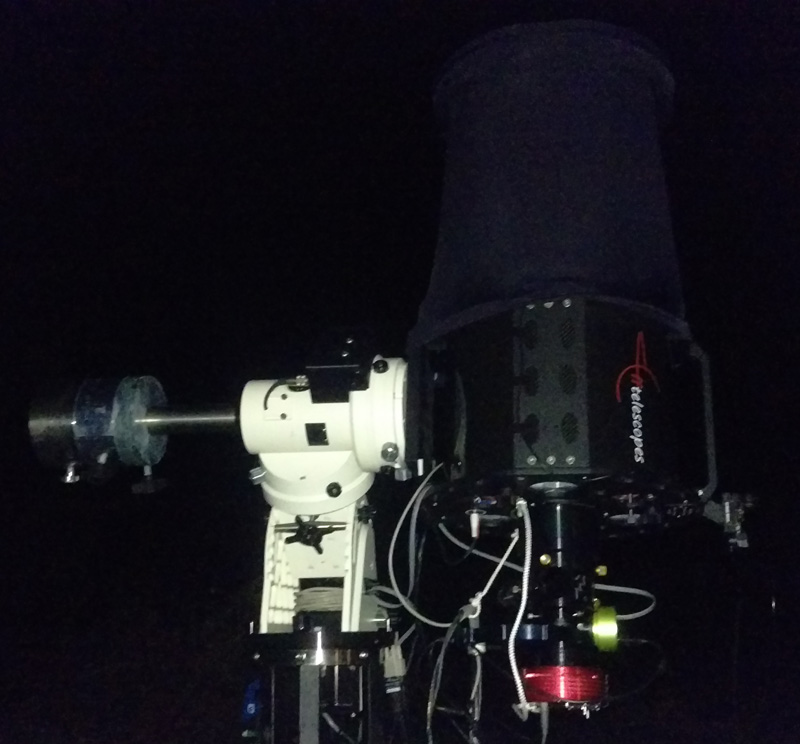
Optical Quality: from the two or three imaging sessions I’ve done so far, the results are significantly better than what I achieved with my C11, so I believe the optics deliver on their promises. My stars are sharper (though I’m still questioning their shape in my NGC 7331 capture), and the field is extremely clean on the KAI 4022 (no visible coma or field curvature in the few images I’ve taken). So far, so good—time will tell. I don’t yet have enough experience to comment on thermal behavior or mirror turbulence (I’ll need those long winter nights to form a solid opinion). But for now, I’m quite satisfied!! 🙂
One important point: The CCDT67 reducer works well with this tube. I end up with a 300mm at F/D 5.4, making it a great “photon funnel” with a medium focal length. Ultimately, it’ll also be perfect for nebulae! 🙂
I’m very happy with the focusing system and the Seletek. It’s precise, easy to use, and most importantly, you no longer have to move 3 kg of gear at the end of the tube. Only the secondary mirror moves, with minimal hysteresis when passing the mirror flop point and returning. My friend, who opted for the focuser/rotator, is also very satisfied, though the approach is different. However, I chose a simple “Feather Touch 3” as my CCD holder, and if I had to do it again, I’d pick something else—I can’t quite trust that it’s locked in a completely reliable way. I still need to work on that…
Edit: I finally went for a Gemini Integra 85 focuser/rotator, which is extremely sturdy. The rotator function is invaluable for fine framing of wide-field objects.
Weight, to finish: 20 kg is the limit for mobile use, in my opinion. I have no trouble mounting it, but any heavier would start to be cumbersome. I think it’s the right compromise before moving to a permanent setup.
Some pictures taken with this scope can be viewed here and here. Others are available in the gallery 🙂
Conclusion
I don’t own stock in CFF, but so far, I’m quite satisfied with my purchase. The price is on the higher side, but it’s not GSO-level either… I think the price is reasonable compared to the market. For me, this was truly the right compromise between GSO and a “high-end” RC, which would have been beyond my physical and financial means. I feel this tube has a lot of potential, and that’s what matters most :). Now, I need to confirm all this with plenty of photos…
Go to the CFF website.
Thanks to Skyvision for handling and shipping the scope.